

A Deadly Water Parasite Is Sickening Healthy Dogs, Top Vets Warn
New research on Heterobilharzia americana, the parasite that causes canine schistosomiasis, is prompting veterinarians to reconsider its geographic reach and which dogs may be at risk.
Once considered a Gulf Coast oddity, Heterobilharzia americana, the parasite that causes canine schistosomiasis, is now grabbing the attention of veterinarians in New York City.
New research suggests the parasite may be more widespread than previously recognized — and may infect dogs with no known history of swimming in freshwater sources, or other classic risk factors.
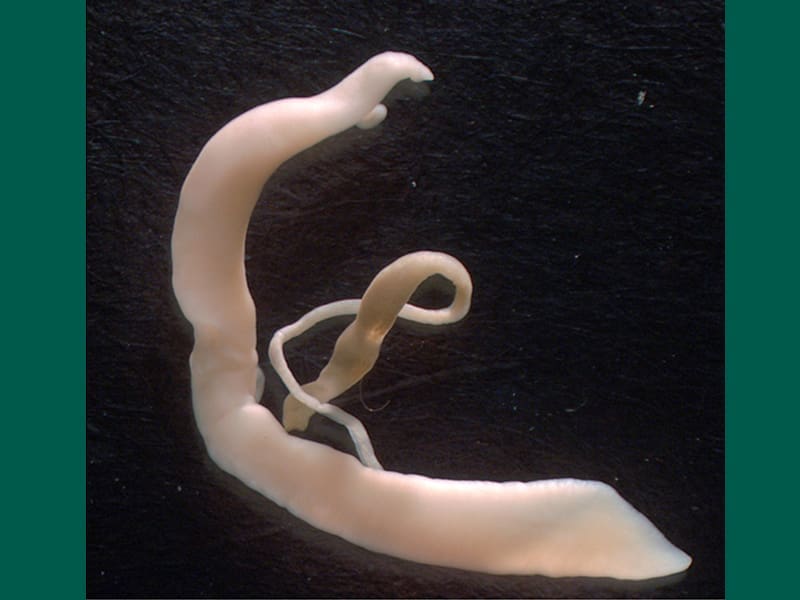
Credit: Companion Animal Parasite CouncilImage Courtesy: CAPC (Companion Animal Parasite Council)
SEATTLE — When I noticed “canine schistosomiasis” on the agenda for a veterinary conference I attended here in June, my stomach dropped. No pun intended.
I had studied human schistosomiasis as an undergraduate at Brown University in a course called “The Burden of Disease in Developing Countries.” I understood it as a devastating parasitic disease associated with poverty, contaminated freshwater and inadequate sanitation in parts of the developing world.
What was schistosomiasis doing on the agenda at a veterinary conference in Seattle? And why was the word “canine” next to it?
My concern grew when I arrived for Dr. Kathleen Aicher’s presentation at the Seattle Convention Center and saw photographs of Labrador retrievers on the opening slide.
Dr. Aicher, a veterinary internist and assistant professor at Texas A&M University’s Veterinary Medical College, was speaking at the annual forum of the American College of Veterinary Internal Medicine, the accrediting body for veterinary specialists in oncology, neurology, internal medicine, and nutrition. It is often where the most consequential, talked about research in the profession is unveiled.
Dr. Aicher told the audience her team had been “astounded” by the prevalence figures they were finding among Labradors considered at high risk for infection — and also among those considered at low risk.
For decades, Heterobilharzia americana was regarded largely as a parasite of the Gulf Coast and southern Atlantic states, where compatible freshwater snails complete part of its life cycle.
Researchers have now documented infections well beyond that traditional range, including outbreaks linked to Utah and California.
Dr. Aicher said dogs from additional states have tested positive through Texas A&M University’s Gastrointestinal Laboratory. She emphasized, however, that the location of a dog when it was tested does not establish where it became infected.
Dogs without the classic risk factors
The parasite’s geographic range may not be the only thing veterinarians have misunderstood.
Dr. Aicher said her team had identified infections in dogs with no known history of regular swimming, water training or other exposure traditionally associated with the disease. In an endemic area, she said, exposure could be as ordinary as standing in a flooded backyard.
In an interview with TCR after the forum, Dr. Aicher described two French bulldogs from the Houston suburbs that had “never left their backyard — and they both were infected.”
Standing water after heavy rain was the team’s best explanation, she said. But without environmental testing, something she and her colleagues say is warranted based on their findings, however, those cases do not establish the precise location or manner of infection. Indeed, the disease may also be present in parts of the country where veterinarians are not yet testing for it.
Dogs move around the United States in ways their veterinarians may not know. Families take pets on vacation. Sporting dogs travel to competitions and hunting grounds. Rescue dogs are transported from Gulf Coast states to shelters and homes elsewhere.
“There are dogs all over the country that are being tested and found to be positive,” Dr. Aicher told The Canine Review.
She said the Texas A&M laboratory had received positive samples from dogs in Wisconsin and Ohio whose veterinarians reported no known travel to historically endemic regions.
Those results are important signals, Dr. Aicher said in her talk, but they do not prove that local transmission has become established. Confirming local transmission requires evidence that the parasite is completing its life cycle in the environment, including the identification of a compatible snail infected with H. americana.
Preliminary prevalence figures surprise researchers
Dr. Aicher’s Texas prevalence study was still enrolling dogs when she presented its preliminary findings in Seattle.
She described the results as “apparent prevalence” and cautioned against applying findings from selected groups of Labradors to the general dog population.
Still, the findings raised concerns, particularly because the researchers identified confirmed infections in dogs without known risk factors.
“In our low-risk Labrador retrievers,” Dr. Aicher said, referring to dogs that did not regularly swim or train in water, “we were very surprised to find 8.3%.”
The preliminary figure was substantially higher among dogs placed in the study’s high-risk category.
“We were astounded by our high-risk counts that nearly 28% of these dogs were positive for Heterobilharzia, which was more than double their prevalence for other intestinal parasites,” she said.
Because enrollment was continuing and the dogs were recruited into defined risk groups, the figures should not be interpreted as estimates of prevalence among all Labradors or all dogs.
They do, however, suggest that infection may be occurring in dogs whose histories would not ordinarily prompt veterinarians to test for the parasite.
California confirms local transmission
That kind of confirmation came in California in 2023.
In 2023, Los Angeles County health officials issued an animal health advisory after 11 dogs from Los Angeles, Orange and Riverside counties were diagnosed with canine schistosomiasis between 2018 and 2023. All had visited the Colorado River before diagnosis. One died.
University of California, Riverside researchers later collected more than 2,000 snails near Blythe, California and identified H. americana in two snail species. They wrote about their findings in a peer reviewed paper. The finding tied infected dogs, capable snail hosts and the parasite to the same location.
Could a dog be diagnosed in New York?
At New York City’s Schwarzman Animal Medical Center, senior veterinarian Dr. Ann Hohenhaus has published this explainer. Click here to head to AMC’s blog.
It is absolutely possible that a dog could be diagnosed with schistosomiasis here in New York,” Dr. Ann Hohenhaus wrote on the blog she publishes for the Schwarzman Animal Medical Center.
“The life cycle of this parasite is, frankly, revolting,” Dr. Hohenhaus writes this week on the AMC blog. “The young flatworms penetrate a dog’s skin and migrate through the lungs into the blood vessels of the liver, where they mature and mate. The adult flatworms lay eggs that migrate into the intestine and are ultimately shed into the feces. If infected feces reach freshwater, the eggs hatch and infect snails. Inside the snail, the parasites mature into free-swimming flatworms, ready to infect another host.”

So disgusting, but also no laughing matter, certainly not for people. “Schistosomiasis affects almost 240 million people worldwide, and more than 700 million people live in endemic areas,” the World Health Organization says on its website. “The infection is prevalent in tropical and sub-tropical areas, in poor communities without potable water and adequate sanitation.”
Why diagnosis is often delayed
“Diagnosis is frequently delayed due to lack of awareness,” Dr. Aicher said during her presentation. Dr. Aicher told The Canine Review her “pie-in-the-sky” hope is for veterinarians across the country to add H. americana to their differential diagnoses. A differential diagnosis is a clinician’s list of conditions that could explain a patient’s signs. Testing and other findings are then used to narrow that list.
A routine fecal examination does not detect the parasite. Veterinarians must order specialized testing when they suspect an infection.
A 2026 study by Dr. Aicher and Texas A&M colleagues reported that a newly developed fecal PCR test had 98.2% accuracy (the authors disclosed that several of them, including Dr. Aicher, are paid employees of the Texas A&M GI Lab, which offers the test for a fee).
[While reporting this story, I grew so anxious about my own Labrador, my primary veterinarian in New York, who had also attended the Seattle conference – and, like Dr. Hohenhaus, had to listen to me carry on about Dr. Aicher’s horrifying slides long after her talk concluded – eased my own fears by submitting Nellie’s fecal sample for testing at Dr. Aicher’s renowned GI lab. The result was negative. The test was sent out on a Friday. We had our answer by Tuesday. And, because Nellie has chronic soft stool and suspected irritable bowel disease, Nellie’s pet insurance carrier, Trupanion, paid for the test.]
The Labrador Behind The Drake Project
It was Drake, an 8-year-old chocolate Labrador retriever patient from the Houston area who “grabbed me and forever changed my career,” she told TCR. The research fund, The Drake Project, is named for the dog, who succumbed to complications from the disease.
Drake “grabbed me and forever changed my career,” she told TCR.
“It was sort of a ‘never again, let’s learn something more about this’ moment,” Dr. Aicher said.
There is no approved preventive medication that reliably protects dogs against H. americana, according to Dr. Aicher. Treatment can be effective, but it may have to be repeated and can involve high doses of medications that cause adverse effects.
Veterinary medicine does not yet know the parasite’s full geographic range. Positive tests from dogs in unexpected places can identify areas that warrant investigation, but only environmental evidence can show where local transmission is occurring.
Until more is known, Dr. Aicher is urging veterinarians not to dismiss the disease solely because a dog does not live along the Gulf Coast — or because its owner says it never swims.